Skip to main content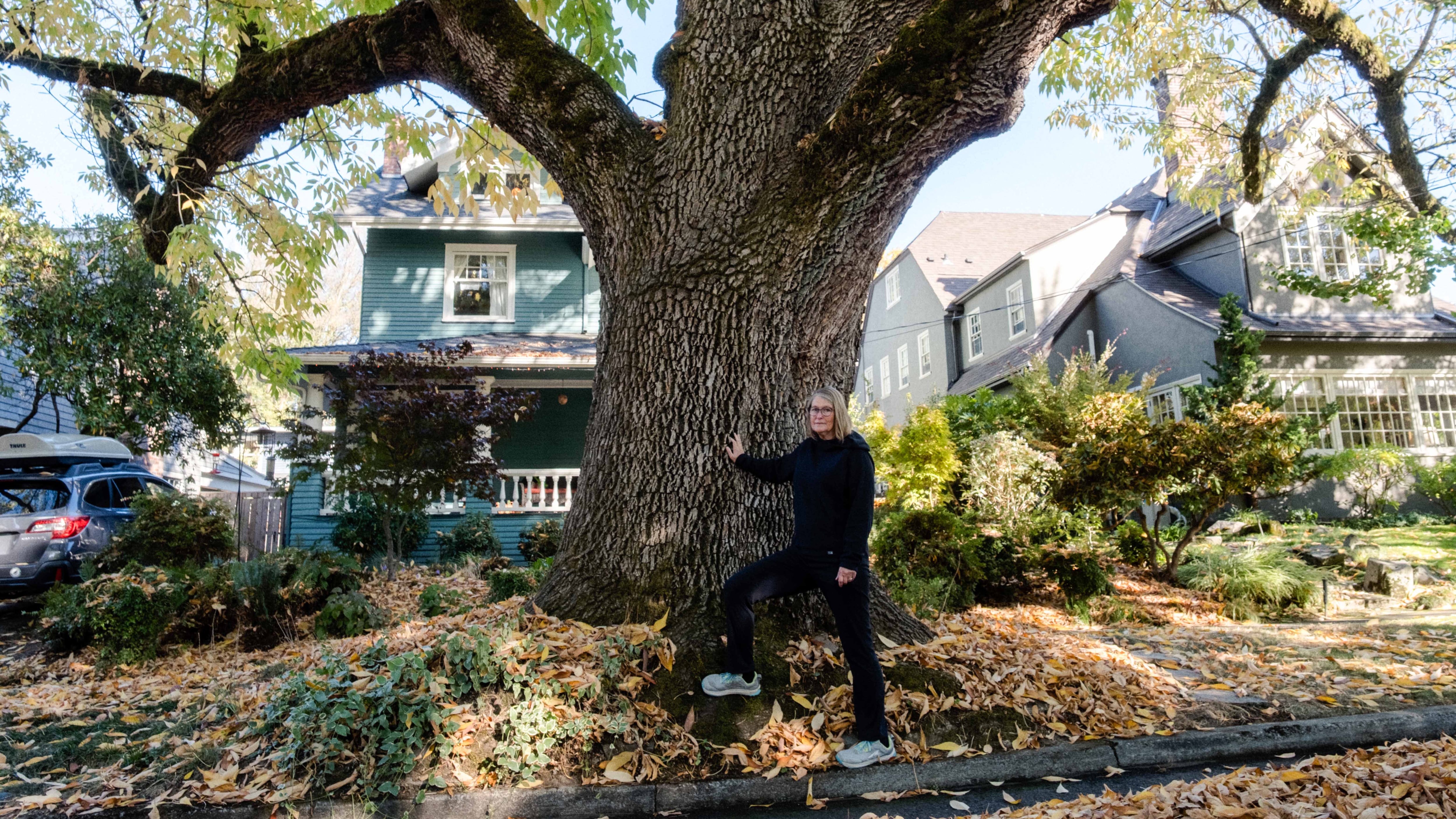
Ever since its accidental introduction into the U.S. in 2002, a pearlescent green beetle known as the emerald ash borer has worked its way across eastern and central North America, wiping out millions of ash trees along the way. It kills 99% of trees it inhabits and has no natural predators in the U.S. The borer creeps through forests hunting for ash groves a few miles at a time, its spread accelerated by the transport of firewood, as the beetle’s tiny larvae hidden in crevices in the bark circulate all over the country.
Experts predict the ash borer will dramatically decrease the population of ash trees, a keystone wetland species. And the beetle has finally found its way to Portland, increasingly present after it was initially detected in Forest Grove in 2022.
It’s yet another ecological crisis on a scale too large to understand, much less communicate. The dormant season of the emerald ash borer begins in October and will continue through April, though experts advise that staying vigilant in the offseason is key to combating the destructive beetles.
Today, I am a few blocks from Laurelhurst Park, attempting to understand what the threat of an emerald ash borer infestation means for Jill Punches and her ash tree.
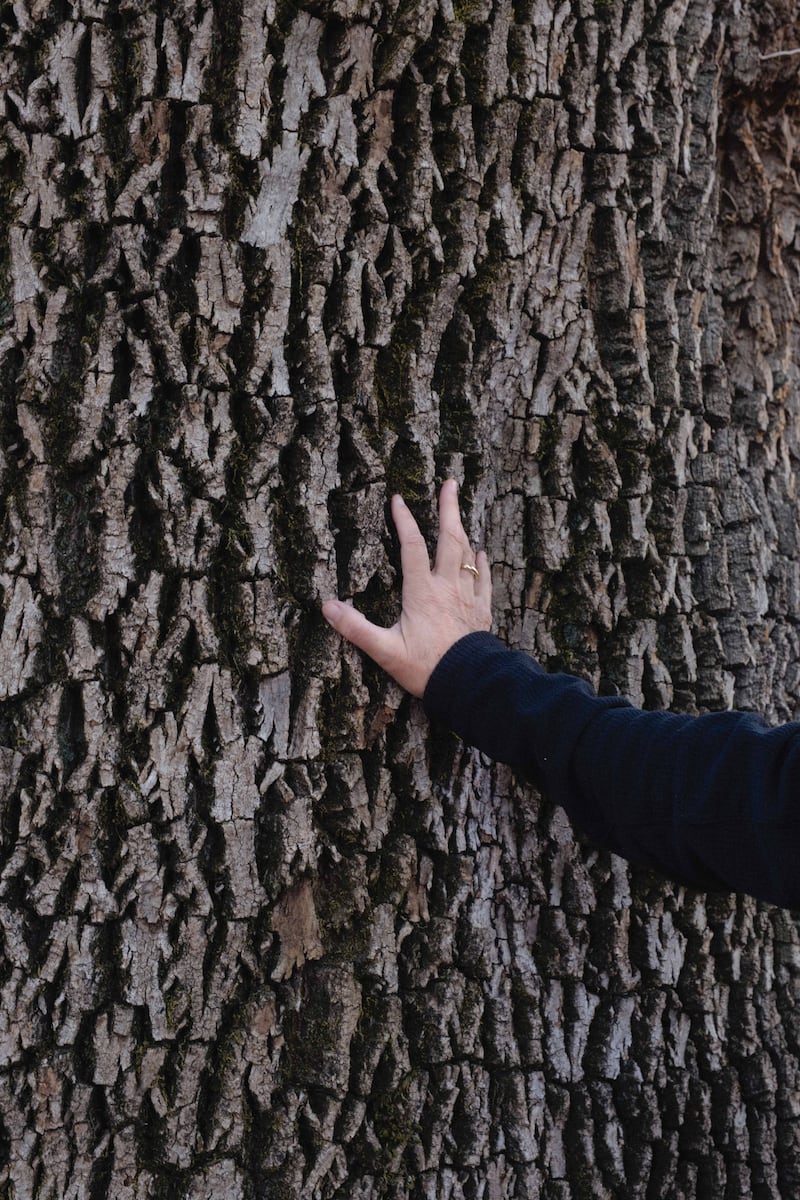
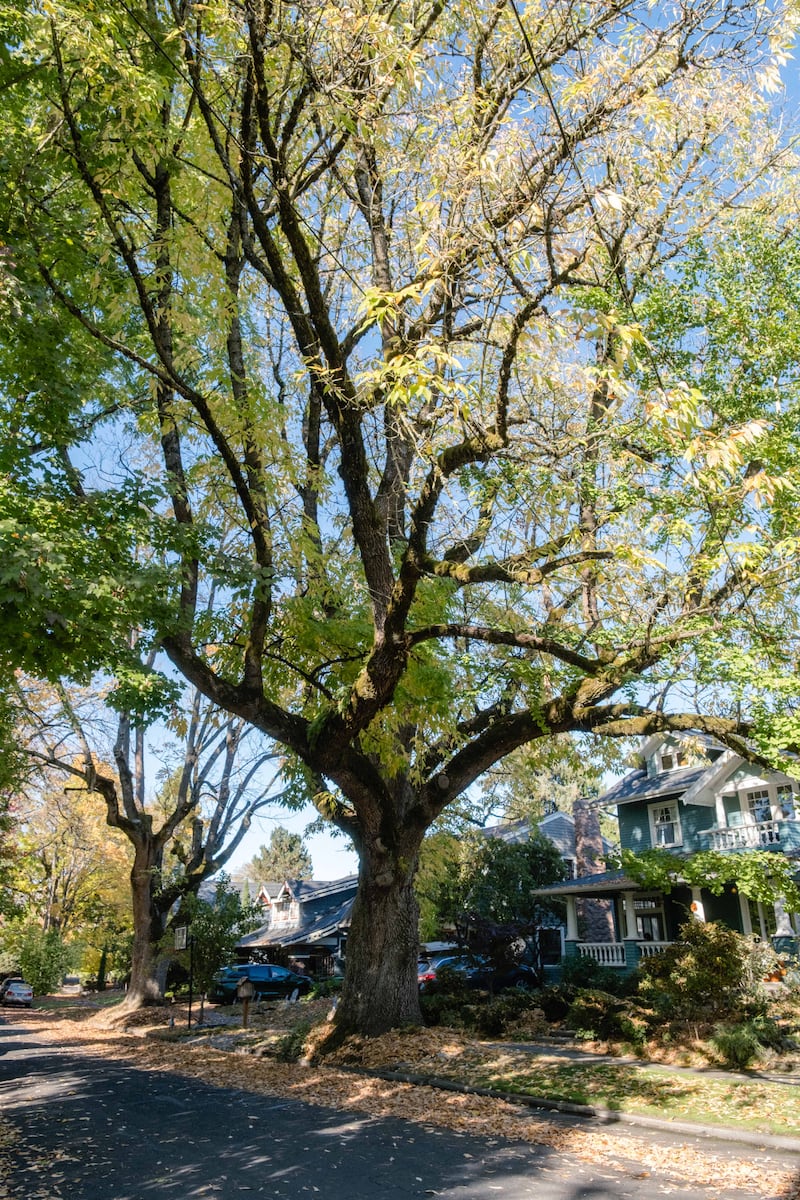
Punches’ ash stands proudly in front of her home between the sidewalk and the street. It’s ornamented with a small plaque bearing its scientific name (Fraxinus americana) and a birdhouse that looks impressively comfortable. The tree’s feathery bark spreads up into stocky boughs blanketed in clumps of ferns. Its dense canopy washes the street with a pleasant lime-green glow.
Fraxinus are easily identified by their unique combination of traits. They have opposite leaves that are also pinnately compound, meaning the “leaves” are actually leaflets attached to a central stalk that are positioned across from each other on the branches. Despite these shared traits, there are many unique forms of ash tree around the globe, from the scrubby, desert-dwelling Fraxinus papillosa to Oregon’s own towering Fraxinus latifolia. The emerald ash borer targets all within the genus, even occasionally targeting closely related olive trees (genus Olea) and white fringetrees (Chinonananthus virginicus).
Once you know what to look for, you’ll begin to see them everywhere. They’re highly adaptable trees and form great canopies, which makes them especially popular for urban planting. Ashes are the street trees in front of the White Stag Building’s iconic Portland sign. Dozens run along Southeast Division Street and Northeast Martin Luther King Jr. Boulevard, and more line the creeks in Forest Park. Ashes are the type of tree that people like to call “charismatic”—the type we crane our necks up at. They are the type of tree you can talk about for an hour over coffee.
Punches’ tree is special among the 100,000 located throughout Portland because it’s designated as a Heritage Tree. This means the tree is “formally recognized by City Council for [its] unique size, age, and historical or horticultural significance.” It also means the city proactively treats her tree with chemicals designed to defend against the EAB, a regimen that has successfully warded it off thus far. Anybody can nominate a Heritage Tree, regardless of ownership. Punches’ ash was nominated by an arborist who did regular maintenance on the tree. He was so enamored by its form he wanted to honor it forever.
Over coffee, Punches launches straight into it, anticipating my questions. She is a contract specialist with Multnomah County, empathetic yet analytical. She has lived in her house since the ’90s, after moving here from Los Angeles. The ash pulled her toward her house, despite its “hideous bathroom.”
She and her husband watched the ash grow alongside their three kids, noticing it more after Jill became an avid birder. The tree provided habitat for dozens of bird species that she could see right from her balcony. She scrolls through what she’s seen, playing snippets of audio she captured herself. It isn’t all birdsong, though. She shows me an album on her phone titled “Tree Fell On House June 2021.”
One summer morning, a huge bough from the ash collapsed on the house. It narrowly missed the porch, averting what could have been a total structural crisis. After thousands of dollars in removal fees, the tree’s canopy was noticeably more open. The effect on temperature was instantaneous. After 20 years of cool summers, Punches had to buy four A/C units to keep her home comfortable. Her entire street is lined with ash trees, and Punches imagines what their loss would mean for her neighbors.
“People tend to think of trees more as liabilities, but they are also assets,” Punches says, directing me to a study in Portland by the U.S. Forest Service in 2008. It found that a street tree with a 20-foot shade canopy adds a total value of $19,958 to surrounding properties. The canopy of Punches’ ash is easily 100 feet wide.
Considering that roughly 4% of Portland’s street trees (nearly 10,000 of the 250,000) are ashes, the potential canopy loss would have citywide effects on temperature and electricity use, not to mention the costs of suddenly having a full-sun garden.
The city of Portland estimates there are 26,000 ash trees on public and private property as well as an additional 68,000 in natural areas. Their loss exacerbates landscapewide issues with heat absorption and climate change.
Still, “it’s not an apocalyptic situation,” says Anya Moucha, the forest pest and pathogen coordinator for Portland’s Urban Forestry division. Moucha says there are two main options when combating the EAB: preservation through chemical treatments or replacement with an appropriately adapted tree. Moucha warns, however, that despite the temptation to retain a mature tree, research indicates removing and replacing a tree costs about the same as chemically treating it for 20 years. Treatment is also primarily a preventive measure; once more than 20% of a tree’s canopy dies from infestation, the ash loses its ability to thoroughly spread the insecticide through its body. What’s more, when expanding the conversation from the beloved ash in your yard to a statewide ecological crisis, one has to get crafty.
Drawing on research by the statewide EAB task force led by the Oregon Department of Agriculture, Portland Urban Forestry issued an extensive response plan in 2025. The guiding strategy is to slow the beetle’s spread to slow its impact. Portland Parks & Recreation and Urban Forestry are approaching pest management through a mix of strategies, including chemical treatment for existing ashes in parks and natural areas, underplanting new species of trees, and proactively removing and replacing trees in poor condition. (For anyone who has an ash tree, the city’s resources on identification and treatment are extensive.)
Mark Ragozzino, a biological control entomologist with ODA, closely followed the emerald ash borer throughout his schooling in Virginia and his bicoastal career.
“The larvae actually girdle the tree,” Ragozzino says, describing the ash borer’s annual cycle. “They feed on that inner layer of the bark that it’s using to move water from its roots up to its leaves.” It may not look like much of a threat at first, but year after year, as generations of the beetle spawn in the tree, Ragozzino says with certainty, “the tree will succumb to it.”
Ragozzino is working in Portland on an experimental biocontrol method: releasing the EAB’s natural parasitoids, a small wasp relative endearingly named the oob. (This also happens to be the topic of his dissertation.) “Researchers went over to Asia…and figured out what attacks it there,” he says. After a decade of rigorous testing to ensure they weren’t introducing a new invasive species, Ragozzino and other researchers began selectively releasing oobs across the U.S.
Female oobs scour the bark of ash trees for ash borer eggs, then lay their own eggs next to them. Once hatched, baby oobs consume the EAB before it hatches. Ragozzino was a part of the implementation and planning of the predator’s introduction in Cottage Grove outside Eugene, which proved effective. Although oobs aren’t aggressive enough to fully eradicate the EAB, they provide another tool to slow the spread and potentially create a future where ash populations can reestablish themselves in limited numbers.
Among the slew of negative effects posed by the decline of ash trees, Ragozzino cites the loss of shade cover for “riparian corridors”—moisture-rich lands along waterways—which will raise water temperatures. Salmon and other fish are most immediately affected, but altering the habitat so dramatically also threatens to uproot hundreds of other species. The removal of a staple ecosystem tree means one less source of resiliency in the shrinking web of life.
Punches tells me one final story as we finish our coffee. As Dutch elm disease ravaged local elm populations in the 2010s, a group of Portlanders established the Friends of Elm Trees, a grassroots organization to chemically inoculate the city’s hundreds of elm trees against the similarly destructive Dutch elm disease. Although it began in Ladd’s Addition, the movement quickly caught on across the city. Punches says she played a key role in the Laurelhurst branch to protect the neighborhood’s elms. To this day, she shares with pride, the trees stand.
As for Punches’ ash, she hopes to replace it with one of its saplings after it passes on, ensuring that its memory never fades away.
Suspected infestations of the emerald ash borer should be reported immediately by phone or online to the Oregon Invasive Species hotline (1-866-INVADER, oregoninvasiveshotline.org). Other resources, including Urban Forestry’s EAB response plan, are available on the city’s website at portland.gov/trees/eab.