Skip to main content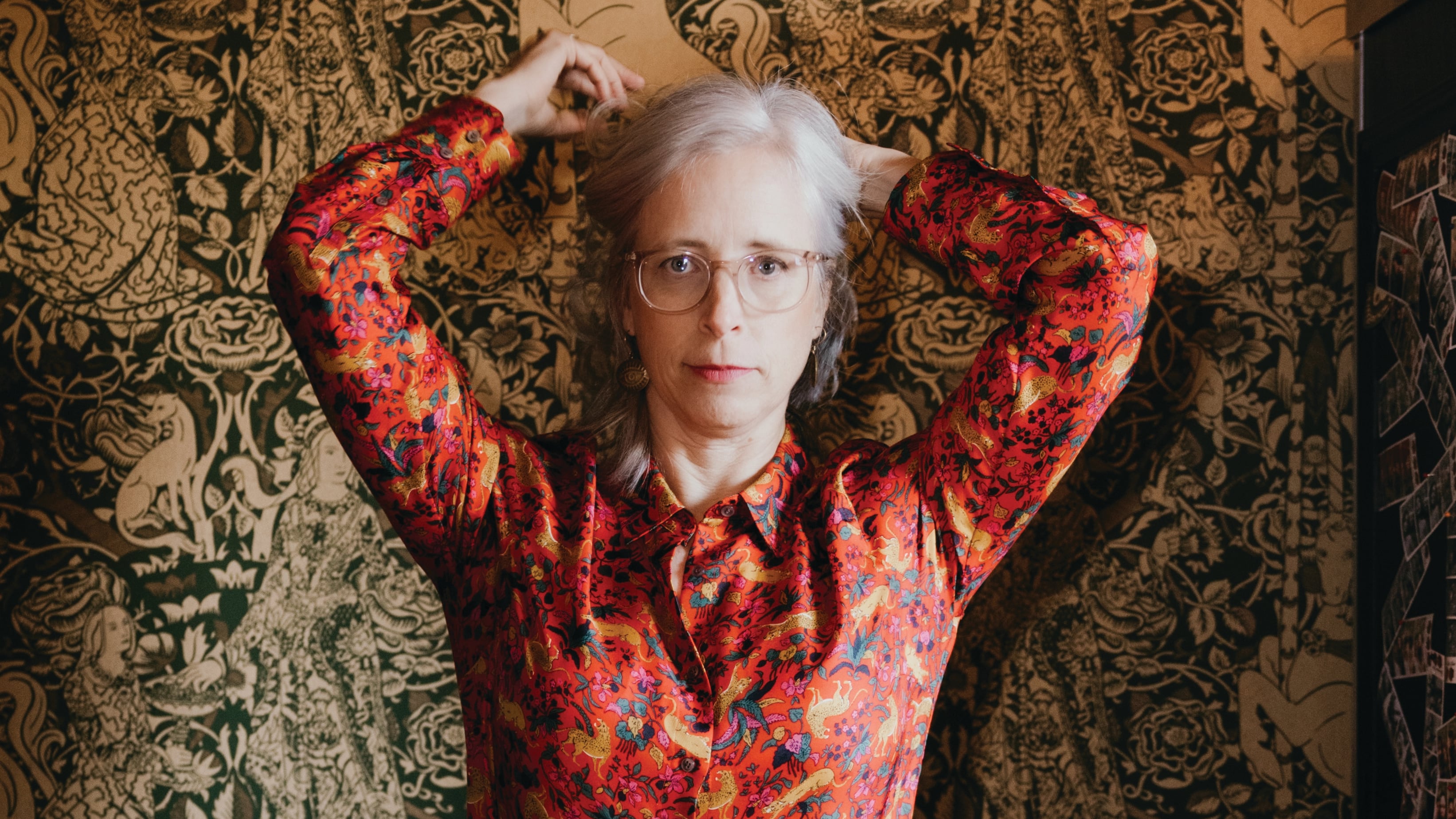
The Temple of Bloom, the tiny backyard studio where Laura Veirs recorded her unvarnished new record Temple Songs, has almost no soundproofing. A big couch serves to cushion most of the unwanted noise. If a plane or a car passes by, she has to wait for the noise to die down. Sometimes, she leaves it in.
“I appreciated the zen of that, that the room isn’t letting you do this,” she says.
Temple Songs, out Aug. 14 through Veirs’ own Raven Marching Band label, is the Portland folk singer-songwriter’s first album to be recorded almost entirely by herself, with a lone appearance on saxophone by a “secret special guest.” Veirs has long entrusted her closest collaborators to flesh out her songs—-most of her earlier records were produced by her former husband, Tucker Martine, while artist-whisperer Shahzad Ismaily contributed to the lush, spectral sound of 2022’s Found Light. For Temple Songs, Veirs immersed herself in the technicalities of home recording and embraced a do-it-yourself approach.
“I took the reins of my vision more in my grip than ever before instead of deferring to other people or asking for help,” the 52-year-old says.
You’d be forgiven for thinking there was a full band given how joyously she jams with herself on prerelease singles “Pulse” and “Flying Into Darkness,” but you can hear the smallness of the room, the sound of her fingers on the frets. Rather than coaxing atmosphere from effects and dense synth layers, as she and Ismaily did on Found Light, she uses the atmosphere of the space itself—the natural reverb, the occasional sound outside—to give her music color.
“It has a little bit of natural room sound,” Veirs says. “It’s not dead. And it’s quiet, because the neighborhood is quiet.”
The engineering aspects were hardest, Veirs says, especially minutiae like mic placement—something recording engineers notoriously obsess over.
“I saw rabbit holes coming,” Veirs says. “People get inside the rabbit hole and sometimes it takes 10 years to get finished, if it gets finished at all. So I was like, I see the red flag—I’m just gonna find this mic.”
The resulting album is quick and stripped down, clocking in just shy of the half-hour mark. Though it’s in line with the quiet and literary folk Veirs has been producing for decades, it has something in common with punk rock—Veirs cut her teeth in the band Rair Kx! during her years at Minnesota’s Carleton College—in its minimalism and embrace of imperfection, but also in its exhaustion with world affairs.
“No Masters” repurposes the early 20th century feminist slogan “no gods, no masters” as an assertion of her autonomy both as a woman and a solo artist finding a new level of trust in herself in her own work; “I can decide what is best for everything in my life,” she sings. Opener “Arc Still Bends” asks rhetorically whether the arc of the world still bends toward justice, and if so, why exhausted citizens like her are so fed up.
“The feeling of being unmoored and lost is definitely on this album because I don’t think any activist I know feels super confident in the progress of various movements right now,” Veirs says. “Does that mean they’re giving up? No, but there’s a question of what is going to move the needle and how we’re going to move it.”
Veirs admits to feeling creatively adrift in the four years since her last record. She hit a bout of writer’s block so bad she considered giving up music. “I was not sure if I’d ever write another song,” she says.
If Veirs had indeed hung up her guitar after Found Light and the subsequent demos compilation Phone Orphans, she’d have plenty of side gigs to fall back on. In 2018, she wrote a children’s book about blues singer Elizabeth Cotten; the same year, she started Midnight Lighting, a podcast on juggling family life and show business that ran for a season. More recently, she’s turned her drawing and painting practice into a solid side gig.
During a trip to Mexico, where Veirs has an ongoing residency teaching creative writing and songwriting at Rancho de la Puerta in Tecate, she had an encounter with a fellow teacher in a hot tub that inspired her to reevaluate. Veirs confessed her creative block, and the teacher told her that she was actually “in a gathering phase.”
“She was right,” Veirs says. “I was gathering the seeds that then became the fruits of this record. I just couldn’t quite believe her at the moment because there was no music.”
In 2025, Veirs married Morgan Luker, a Reed College ethnomusicologist, at a ceremony at Mississippi Studios. She’s added both him and his two teenagers to the family along with her own biological kids, both of whom are around the same age. “They’re awesome kids, and they all get along, but it’s pretty chaotic with four teenagers,” she says, noting it’s not unusual for more than a dozen kids to show up at their house. “We go to Costco now.”
But when Veirs steps into the Temple of Bloom, all noise fades away except the sound of her guitar and whatever’s going on outside.
“It’s six steps from the house,” Veirs says, “but it’s a thousand miles away.”
SEE: Laura Veirs at Music Millennium, 3158 E Burnside St., 503-231-8926, musicmillennium.com. 5 pm Saturday, Aug. 15. Free.