Skip to main content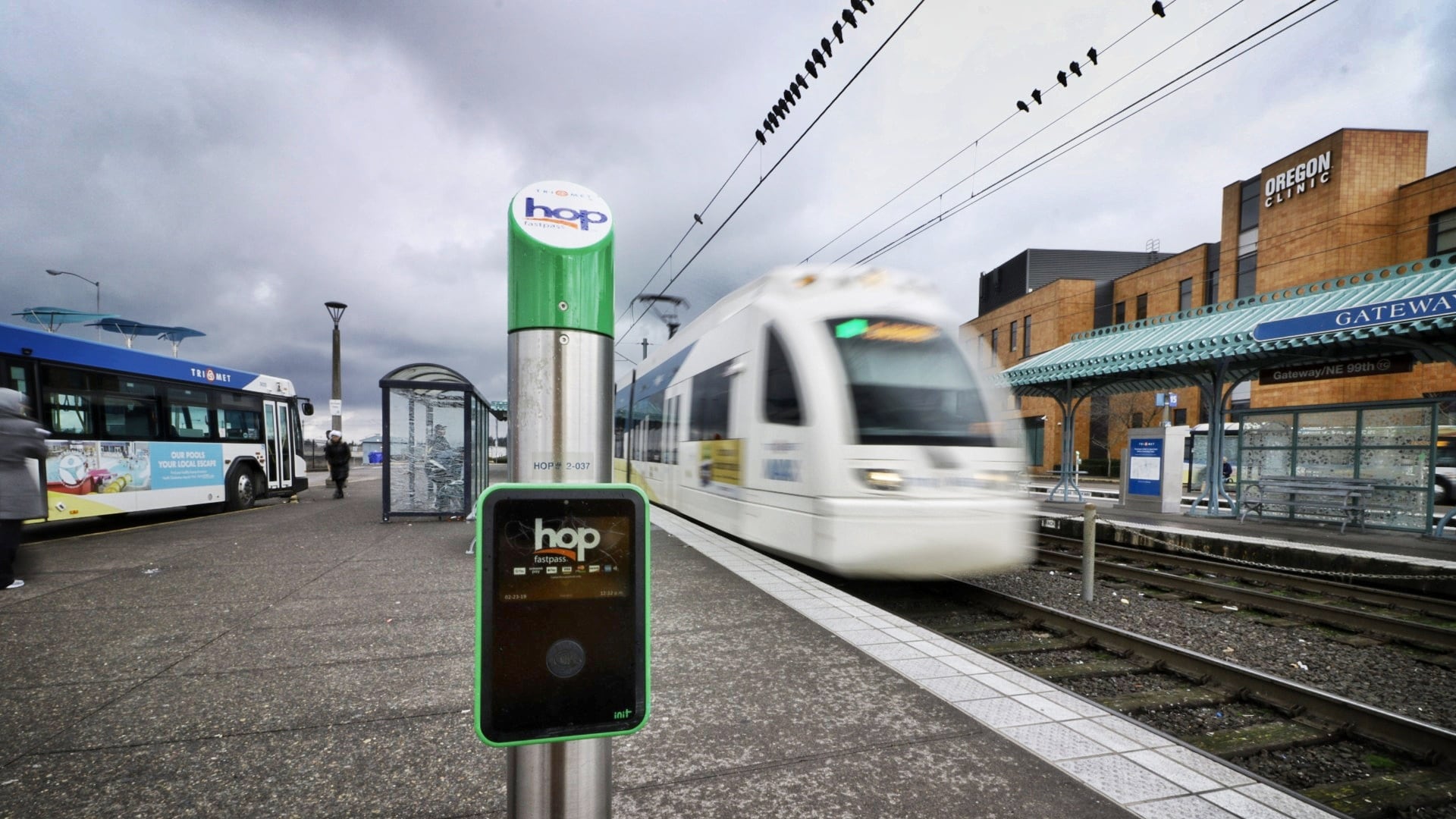
Over the weekend, TriMet will drastically reshape services as it contends with a severe financial crisis and existential questions about its future.
By Monday, 33 bus lines will be altered: relocated, renamed and reduced in length. Two will be eliminated. The MAX Green Line will no longer serve downtown Portland. It will instead be shortened to run between Clackamas Town Center and the Gateway Transit Center.
Overall, it’s the largest service reduction for Portland’s regional transit agency since April 2020, when it temporarily reduced services 20% at the start of the COVID-19 pandemic. The MAX has never been scaled back to this extent, according to TriMet spokeswoman Tia York.
“This is a historic change for TriMet,” she says.
The reductions were first announced in January, as a state transportation funding package crumbled in the face of a Republican-led grassroots revolt. They became a certainty in May, when voters rejected a gas tax proposal that would have included fee hikes to preserve transit service. Now the changes have arrived—and buses won’t.
To notify riders, TriMet crews have papered the metro area’s bus poles and transit centers—from downtown to the suburbs—with 3,500 signs, all with a QR code directing riders to a website that details the pending cuts and how they can plan trips accordingly. York says the website is intended to give anxious transit users “peace of mind.”
With a total budget of $1.75 billion, TriMet is looking to address a $158 million deficit through staff reductions, scaled-back routes and other spending cuts. Since last summer, it’s eliminated 500 staff positions to around 3,200 today.
In many ways, the agency’s financial problems are not unique, according to Portland transit consultant and author Jarrett Walker.
“The problems are the same everywhere,” Walker says. “TriMet’s funding crisis is largely identical to the crises being experienced by many other agencies across the country.”
Issues include the rising cost of labor, due partly to competition from the delivery industry. Agencies now contend with rising fuel and security costs. Fare revenue continues to decline across the board with many workers no longer commuting. (TriMet has only recovered about 70% of its pre-pandemic ridership.)
Around the country, transit systems rely on different funding sources. In red states, it’s often a sales tax. In blue states, it’s regularly a mix of sales, income and property taxes. Some major transit systems get money from motor vehicle excise taxes. Seattle’s system gets money from car registration fees.
Portland is unique—perhaps unfortunately so—in that its transit system is funded primarily by payroll taxes, a funding source regarded as highly volatile with the economy. Payroll tax receipts here have been diminishing in Oregon since around 2024. The payroll tax is also tied to the idea of commuting, where employers pay to help solve a congestion problem they all contribute to. But the work-from-home movement has exploded this assumption, and many people now do their jobs without contributing to transportation demand.
Statewide, the search for transportation funding continues. A $4.3 billion transportation package was rejected by Oregon voters in May. “We are relentless in our search for new revenue,” York says. “We don’t believe we can cut ourselves out of this financial crisis. We’re leaving no stone unturned.”
TriMet will likely have to make further reductions to address its remaining $158 million budget gap. Officials previously planned to make another 10% worth of cuts next year; now York says the plan is to hold off and evaluate this first round of cuts and current staffing levels.
Walker believes in the next few years, regional leaders must have tough conversations about what kind of transit system the area wants now, and how it will be funded.
“Our problem is that transit is everybody’s seventh priority,” Walker says. “We have so many other crises that are higher priorities for our leaders right now, but that doesn’t mean this one is going to wait until all those other priorities are resolved.”